Simplifying professional podcast studios with Buttons
A podcast is one of the most direct forms of communication: a spontaneous conversation between people, captured without complex editing, cutting or additional inserts. The technology behind it should work the same way, powerful enough to meet creative requirements in the highest quality, yet simple enough that a non-technical host can just sit down, push a button and talk. With the Buttons control platform from Bitfocus, it does.
That is the experience Digital Garage set out to deliver. The UK-based systems integrator, with a global reach, had a clear vision: a studio so well automated that any host or producer could run it themselves, with no need for a technical team on hand. It needed to suit everyone, from individual content creators through corporate communications teams to commercial studio owners looking to achieve high throughput.
“Our customers are people who use their podcast studio every day, or own them and want to maximise revenue by minimising set up time.” said Jason Hoad, solutions specialist at Digital Garage. “They want to be able to start work quickly and efficiently and what could be easier than pressing one button to activate cameras, lighting, mics and recording all at once! And for a solo operator, being able to frame the cameras from the presenters desk is a godsend. For the studio owner, that also means more throughput so more revenue.”
Hardware agnostic automation
To make this happen, in a hardware-agnostic concept, Digital Garage turned to Bitfocus and the Buttons control platform. Buttons is designed just for this sort of application: users design workflows and establish presets, then at showtime everything is handled automatically with the minimum of operator control.
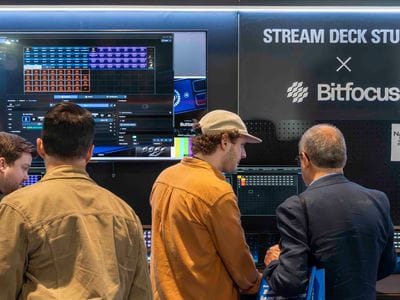
Buttons partners with the Elgato Stream Deck, which gives the operator a simple control panel, with dynamic keys identifying what each function does. It means that a studio can be set up, and a complete podcast recorded, with just a couple of button presses on a panel in front of the host.
“Buttons has control of every piece of hardware,” said Tom Gill, design manager at Digital Garage. “It gives broadcast levels of quality to people who may not have the knowledge to operate each piece of technology individually.
One button, one second
“The ultimate ability is to provide a single ‘Go’ button,” Gill said. “Stacked on that are 25 actions that are simultaneously fired, taking the studio from complete dark with everything switched off to podcast show recording. One button; one second between studio completely off and studio live.”
Buttons is completely hardware agnostic: it has a library of more than 750 connections to third-party pieces of equipment. Users and system designers like Digital Garage are free to choose precisely the right equipment to achieve the results they need, confident that each device will be correctly managed, monitored and triggered by Buttons.
Buttons also integrates tightly with systems that provide automatic camera switching, cutting between camera angles live as the conversation flows. Getting the edit right as it happens eliminates the time-consuming and costly post-production editing that a multi-camera show would otherwise demand, making the whole production slicker and far more cost-effective.
For the studio manager, this simplicity of operation translates directly into faster turnaround between sessions and greater throughput. And that, in turn translates directly into better return on investment. You build a studio knowing that it can deliver session after session with minimal technical support at high occupancy.
Simple, efficient control
“Our goal is a podcast studio providing professional camera switching, audio control, lighting, recording and more, using best of breed products,” Digital Garage’s Gill said. “Normally this would call for a production gallery and a team of operators. By deploying Buttons as the control layer, all the equipment can be locked away in a server room and the whole thing self-operated from the podcast desk.
“Complete control is in the hands of the talent: all they have to do is press a button to start; press another to stop. It is simple, sure and direct.”