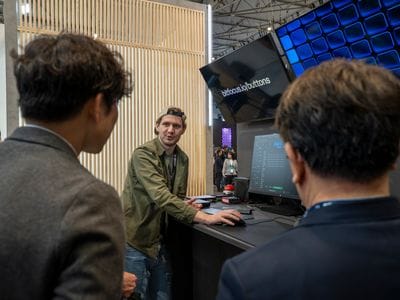
How Buttons played a crucial part in Dota 2 The International 2025
Published on January 28, 2026
ButtonsStoriesCase Study
In the world of esports, TI – The International – has grown to become a massive presence. The 2025 edition was hosted at the Barclays Arena in Hamburg, and featured Dota 2, the deepest multi-player RTS (realtime strategy) game. 16 teams competed for the title.
PGL, the leading production company for esports, was responsible for bringing together the thousands of fans in the arena with a potential audience of millions around the world. In turn, they brought in live streaming OB company Motions to realise the vision.
A complex production with multiple sources
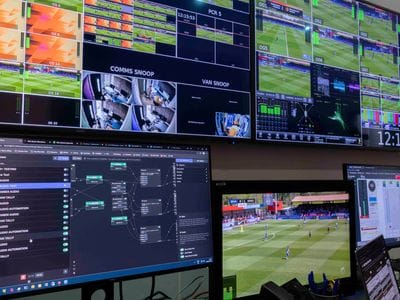
This is a very challenging task. There are large numbers of sources: cameras capturing the charged atmosphere in the arena, feeds from all the plays and players, replays of key moments, additional graphics to tell the story and engage the viewer, and sound effects to underline the action.
These sources need to be cut and mixed for multiple audiences. There are large screens in the hall for the live audience, plays and replays for the analyst panel, and two live streams: a world feed for downstream customisation and an English feed with commentary. There were also dedicated feeds of all material to the PGL headquarters in Bucharest and the TI base in Mumbai.
The technology rig was large. It included FOR-A production switchers and Lawo audio desks; Riedel MediorNet connectivity and Bolero communications; specialist equipment from companies like Disguise and IoCore for interfacing with the game computers. There were 21 cameras, including five with Vislink wireless connectivity.
To achieve excellent results for the multiple outputs called for more than 100 in the crew. Under the pressure of a long live event, the production needed simple, secure and clear control. The esports world was already comfortable with Companion, Bitfocus’s original open source control platform, so it was natural to migrate to Buttons.
Scalability and seamless transitions
“Companion has been a big part of esports since the beginning,” said Gustav Nyberg Comms & Systems Integrator. “It wasn’t hard to bring people on board with Buttons because of that familiarity. It’s just like a big brother, taking it a lot of steps further. I’m not certain that everyone has realised we have moved to Buttons, the transition has been so seamless.”
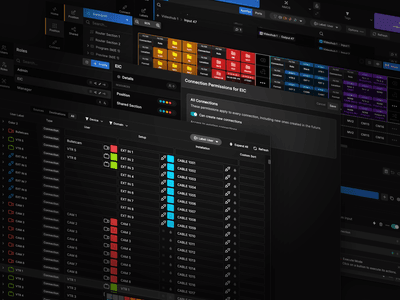
It is the power of Buttons to simplify set-ups and create seamless workflows that impressed. “Scalability is one of the core things,” said Nyberg. “The video router in the truck has 100 inputs and 100 outputs: with Buttons I can set it up in 15 seconds. If I create a button for camera one, then I can just click repeat and it automatically creates buttons for 10 more cameras."
“What this does is shift the focus from what has to be done to what could be done ,” he said. “It opens up creativity because it brings simple operations – the guy running the analyst feeds just has two [Elgato] Stream Decks.”
Elgato hardware - a key component
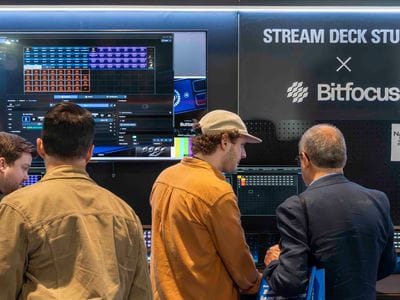
The primary control surface for Buttons is the Elgato Stream Deck. Once configured, Stream Decks provide a simple and foolproof means of control, putting the right functionality where it is needed without unnecessary complexity.
For TI, the architecture included five Stream Deck Studio 1U panels with a large number of customisable buttons and two rotary encoders. It also used more than 10 Stream Deck XL 32 button panels, with Network Docks providing complete control around the rig so operators anywhere in the facility could control the equipment they needed, wherever it was physically located.
Because Buttons can control virtually anything, and build stacks and workflows into single keys, PGL was able to use it for dynamic control, driving decision-making and responding to events. Presenters and actions can be cued, with any effects or graphics linked to a single button press.
Triggers, cues and "nice to dos"
As an example, one of the critical action points in Dota 2 is “first blood”. It’s obviously key for the players, but for viewers it wins them “Loot” on the Steam platform. At TI, the game triggers Buttons with instant notification of first blood, which then automatically sets off multiple actions, not just with graphics on the streaming feeds but on the in-house screens, telling the audience to check their Steam accounts and building excitement.
Similarly, directors can cue a replay in Buttons, which sequentially fades the live feed, mixes to the vMix playout machine, and returns when complete, triggering the show caller to resume commentary.
“It is so quick and easy to set up functionality that we took the opportunity to add some nice tricks, “Nyberg said. “The caller for the world feed happened to mention his favourite song, the music he turns to for a happy moment. So we gave him a button which played an audio file of the song in his headset, whenever he needed it."
“I was tempted to prank the video engineers by programming a scream any time they touched a camera RCP panel,” he added. “We haven’t done it yet, but it will happen when they least expect it.”
Throughout the production, David Thåst, Senior Broadcast Coordinator at PGL, emphasised the ease of creating functions and workflows. He highlighted how Buttons enabled the building of logical production flows, providing everyone involved with a simplified, unified user interface. “What Bitfocus gives us is a way to make complex architectures work simply, work the way we need them to work."
“It means we can concentrate on the relationships between the human talents in making a programme,” he said. “Even something as complicated and massive as TI can be handled calmly, professionally and with a certain amount of fun. Because of this, Buttons is far better than the competition.”